

Europäischer Musikverlag
School for French Horn
School for French Horn
Year of publication: 2015 , 104 pages, Weich , Language: ENG – Englisch, DEU – Deutsch, and FRA – Französisch
Couldn't load pickup availability
From the foreword by Henri Kling:
"This method is written for the French horn (natural horn) and the valved horn. I strongly recommend learning the French horn first in order to truly acquire a beautiful tone. Unfortunately, very few horn players possess this because they treat the instrument like a piston or trombone, thereby robbing it of its own unique character."
Some of the pieces included in this method are written for two horns. If students alternate playing both parts with the same embouchure, they will truly come to know the instrument in its full range. Students should practice only those pieces that do not exceed their current skill level. They should proceed step by step, from lesson to lesson, strictly adhering to the sequence of the individual exercises. Students should stop practicing when they notice that they are becoming fatigued and that the beauty of their tone is diminishing.
And so I hope that the effort I put into this work was not in vain, and that the school will contribute to training truly good horn players."
Contents of this horn school:
3 illustrations: The posture of the horn
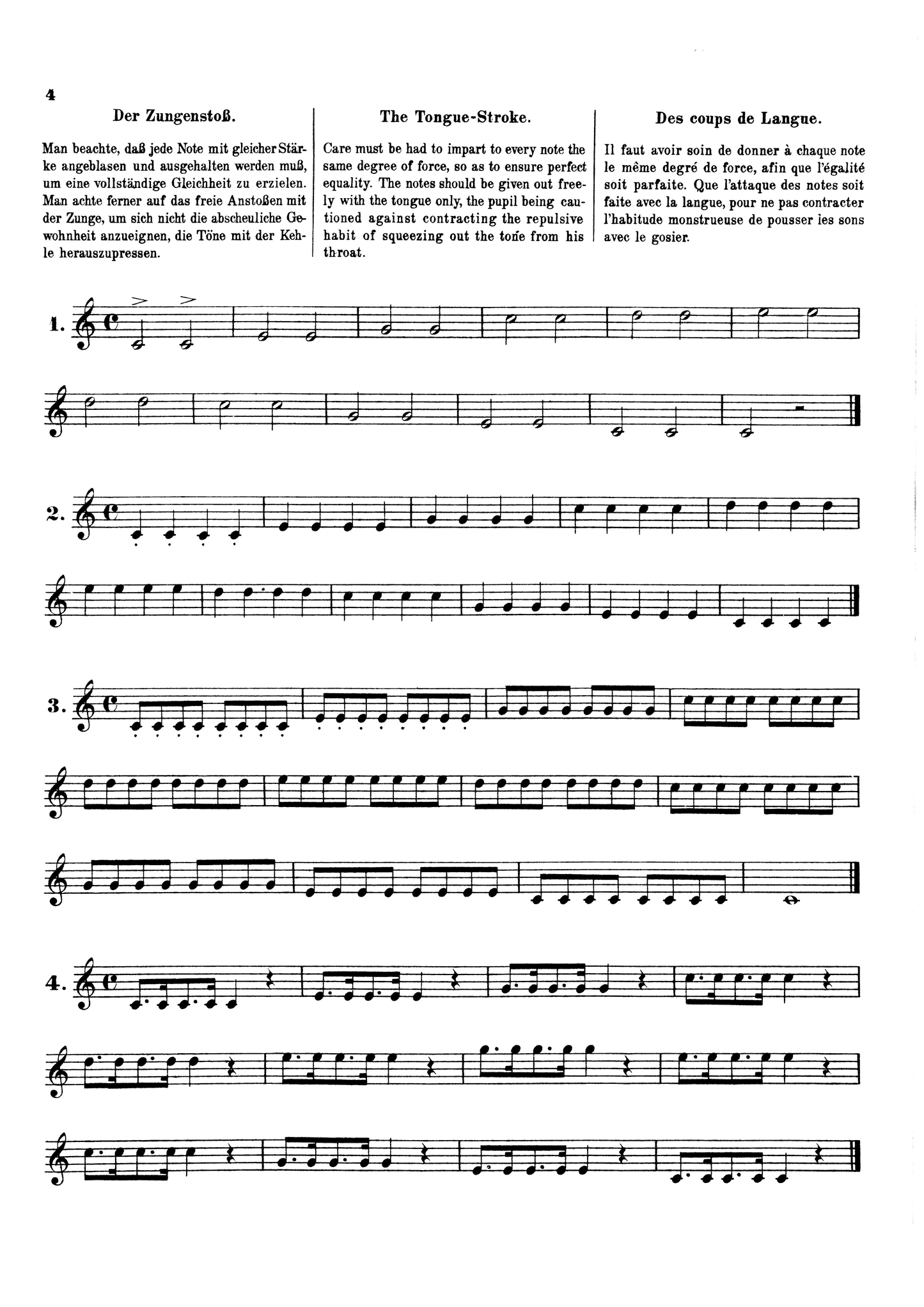
Preparatory exercises. The attack of the notes.
The tongue thrust
Short practice pieces with tongue thrust.
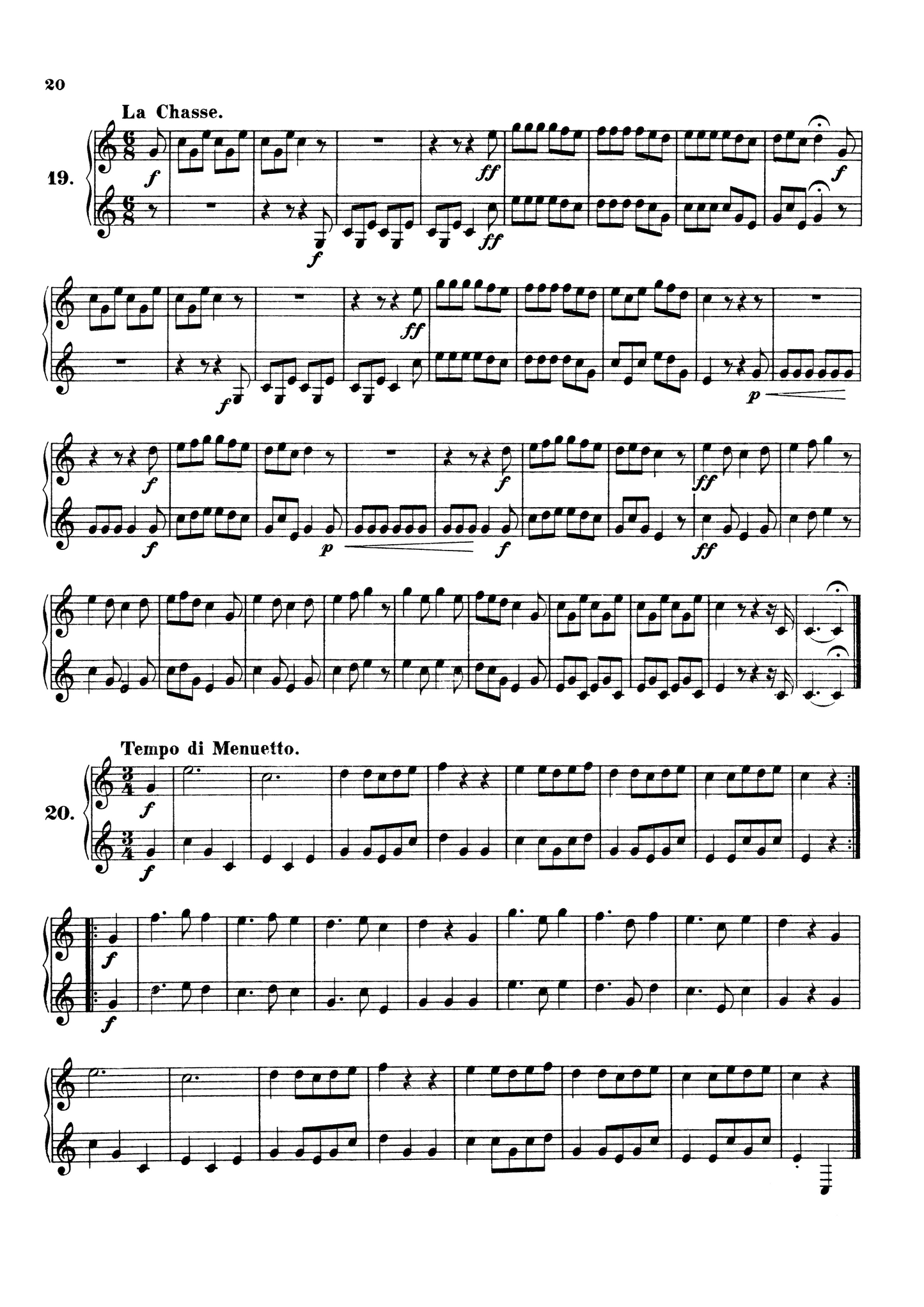
Duets
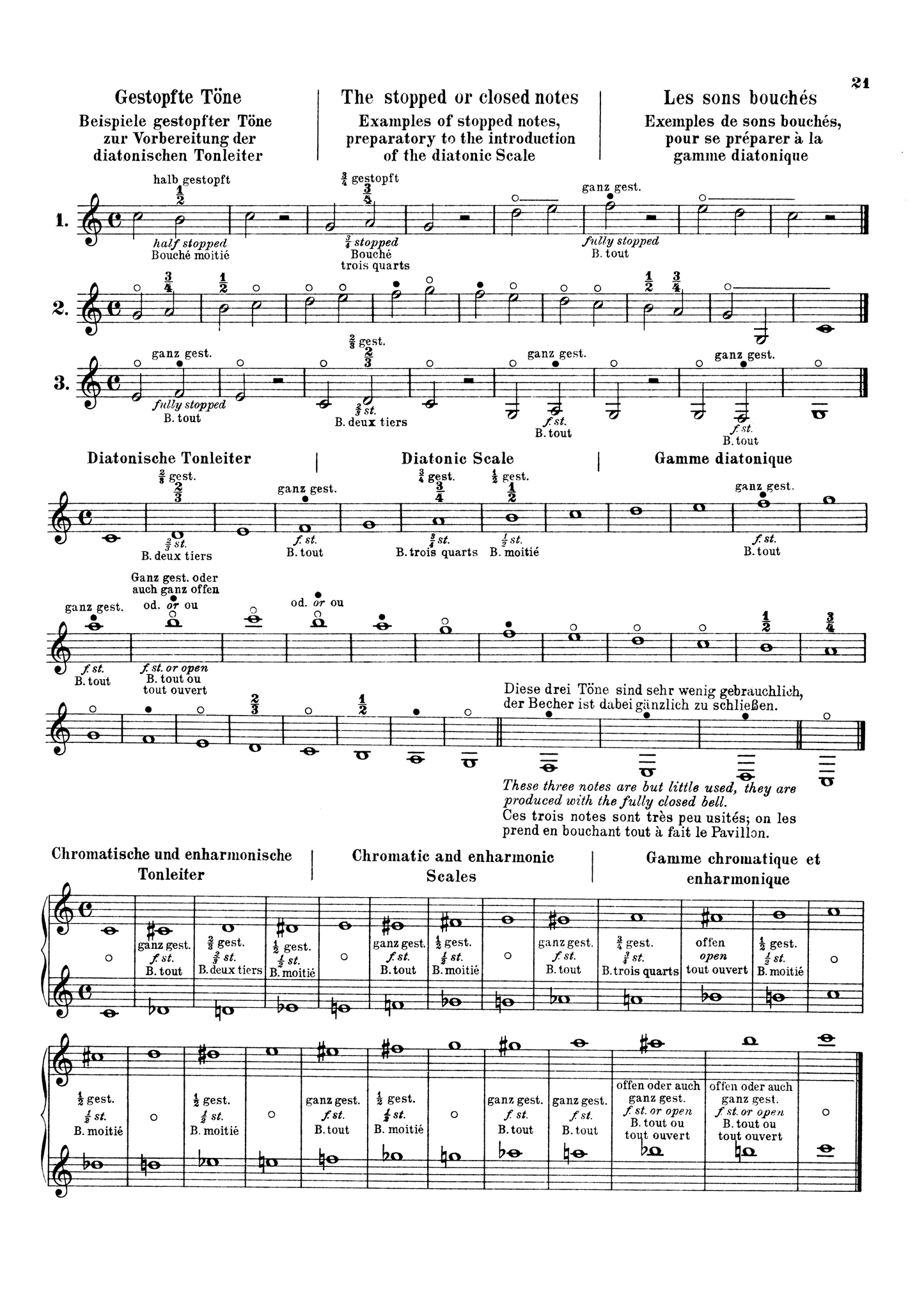
Muted tones
The valve tones
Easy folk songs as performance studies
The transposition
Major and minor scales
Exercises for natural horn in the diatonic scale
Exercises in intervals
Exercises in chromatic intervals
Chromatic exercises
Tied tones
Continuation of the duets
The ornaments in music
Easy, progressive exercises
Exercise for sustaining the tones
Exercises in the C major scale
Scales of different keys
Broken chords
Thirty exercises for articulation
The simultaneous production of double and triple tones
The echo
Practical advice for orchestral musicians
Six characteristic studies
Six Great Preludes
Appendix: Difficult orchestral passages found in symphonies and operas